









By Juan Carlos Valda – jcvalda@grandespymes.com.ar
There comes a point in the life of every SME when the problem stops being “finding people” and becomes finding the right people for the stage the company is going through. This is not a minor issue, nor an operational one, nor merely an administrative Human Resources matter. It is a strategic decision, even though it is often treated as just another recruitment process.
In the early years, companies tend to rely on “all-rounder” profiles: people who do a bit of everything, solve problems on the fly, learn by watching, and compensate for the lack of structure with goodwill and commitment. That model works… until it doesn’t. A common mistake among SME owners is insisting on the same type of profiles when the company has already outgrown that stage. 
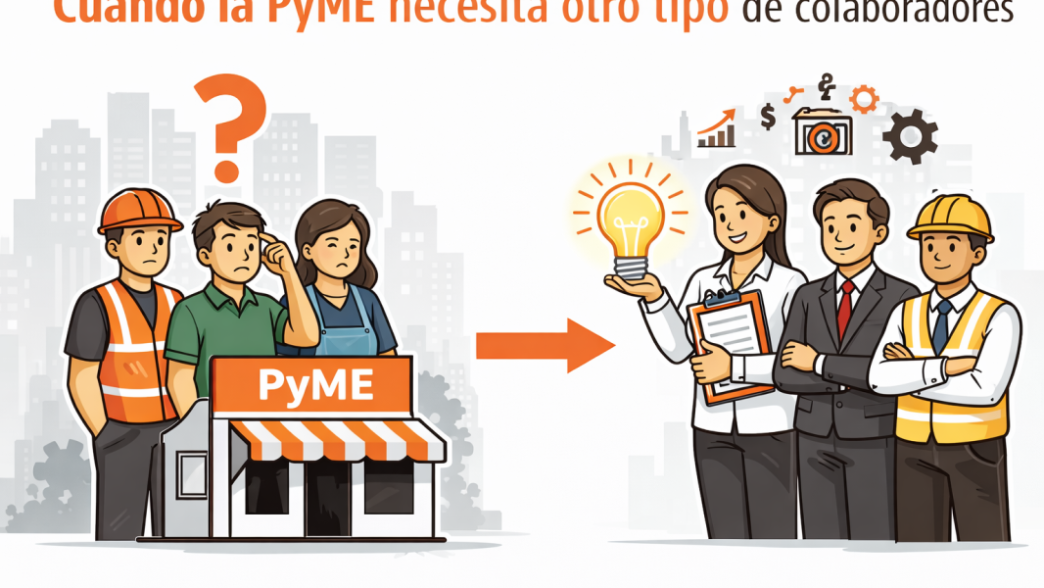
The first key point: it’s not that people are bad — the context has changed
As a company grows, its complexity changes. There are more customers, more processes, more risks, more money at stake, and more decisions that can no longer be made “by gut feel.” At that point, continuing to hire profiles designed for a much smaller organization not only fails to add value, but can actually destroy it.
This is where a frequent confusion arises: assuming the problem is the person, when in reality the issue is the misalignment between the collaborator’s profile and the company’s stage of development. Not all good employees are good for every phase. Acknowledging this is neither disloyal nor dehumanizing; it is a sign of managerial maturity.
Before looking for people, be clear about the company you are building
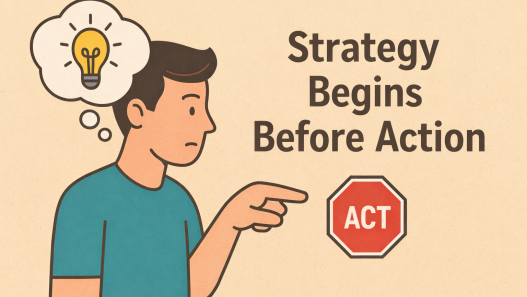
The most expensive mistake in hiring is not made during the interview, nor in the résumé review, nor even in the technical assessment. It happens earlier: hiring without having clearly defined why that person is needed.
When an SME brings in more professional profiles without having minimally organized its management model, frustration is almost inevitable. The owner feels “they don’t adapt,” the employee feels “everything is chaotic,” and the company ends up worse off than before — with higher costs and less focus.
That is why the first question is not “Who should I hire?” but rather:
- What decisions do I want this person to make, and which ones not?
- What problems should they help me anticipate, not just solve?
- Where do I expect them to add judgment, not just execution?
If these answers are unclear, the hiring process is a shot in the dark.
The hardest shift: from doers to business thinkers
There is a very clear inflection point in the professionalization of an SME: when it stops needing only people who do things and starts needing people who think. Not abstract thinking, but thinking about the business, processes, numbers, risks, and priorities.
This does not mean filling the company with “theorists,” but rather incorporating profiles capable of:
- Reading information and turning it into decisions.
- Anticipating problems instead of constantly firefighting.
- Debating ideas without turning it into personal conflict.
- Understanding how their area impacts the overall result.
Many owners say they want this type of collaborator, yet at the same time maintain a leadership model that pushes them away: centralized decisions, limited information sharing, and little room for dissent. You cannot ask for critical thinking and punish those who think differently.
How to approach hiring without getting it wrong
A well-run hiring process does not start with posting a job ad; it starts by realistically designing the role. Not the ideal role, but the role that is actually possible within the current company. Promising autonomy when everything still goes through the owner is the perfect recipe for failure.
From the outset, three things must be made explicit:
- What is organized and what is not in the company.
- What is expected in the first six to twelve months.
- What real decision-making authority the person will have.
Transparency does not scare good candidates; on the contrary, it filters them. Professionals who want to create value want to know what they are getting into. Those who only seek impressive titles tend to walk away when they hear the truth.
The criterion almost no one evaluates — and that changes everything
SMEs tend to evaluate technical knowledge, previous experience, and, at best, attitude. But there is a far more decisive criterion for value creation: the ability to read context.
A strong profile for a growing SME is not the one who “knows the most,” but the one who:
- Understands that not everything is perfect.
- Knows how to prioritize with limited resources.
- Tolerates ambiguity without becoming paralyzed.
- Can build structure without turning it rigid.
This type of profile does not always come from large corporations. In fact, those who fail most often in SMEs are sometimes the ones who only ever functioned well in highly structured environments. Misinterpreted experience can become a liability.
The interview as a strategic conversation, not an interrogation
Interviewing is not about verifying what’s on the résumé — that’s the easy part. A real interview is a conversation aimed at understanding how the person thinks. Clear signals of potential value appear when candidates:
- Ask uncomfortable but relevant questions.
- Show interest in the business model, not just their area.
- Try to understand how decisions are currently made.
- Ask about success criteria, not only about tasks.
If the interview revolves only around “what they did,” but not how they think, you are hiring execution, not judgment.
Onboarding: where the investment is won or lost
Many SMEs do a good job hiring and a poor job integrating. Bringing in a more professional profile and dropping them into a disorganized company, without context or reference points, is like asking them to build a bridge without blueprints.
The first months are critical for value creation. At this stage, it is essential to:
- Explain the logic of the company, not just the processes.
- Share key business information.
- Clarify what is non-negotiable and what is flexible.
- Create real spaces for dialogue with the owner.
If the entrepreneur is not willing to invest time here, it is better not to hire higher-level profiles at all, because frustration will be inevitable.
The most uncomfortable question: are you ready for this kind of collaborator?
This is the question few ask themselves honestly. Bringing in value-adding profiles means accepting that:
- They will question you.
- They will see things you do not currently see.
- They will demand consistency between what you say and what you do.
Not every entrepreneur is ready for that — and that’s okay. The real problem is claiming to want professionalization while behaving as if nothing in leadership needs to change.
Value creation does not depend solely on the collaborator’s profile, but on the system into which they are placed. Valuable people in poor systems either burn out or leave. And the cost is not only economic — it is strategic.
There comes a moment when an SME needs a different kind of collaborator because it needs a different way of thinking about the business. This is not about replacing people, but about evolving the system. The right hiring process starts with strategic clarity, is sustained by leadership coherence, and is consolidated through a model that allows thinking, deciding, and improving.
When this is understood, hiring stops being a recurring problem and becomes one of the main levers for value creation. When it is not, it turns into a constant source of frustration, turnover, and burnout — a cost no SME can continue to afford.
Find more articles by Juan Carlos Valda at:
https://grandespymes.ar/category/articulos-propios/